Working with Persons in Wikibase
Adding persons as named entities to Wikidata or a Wikibase

Data & Metadata Provenance
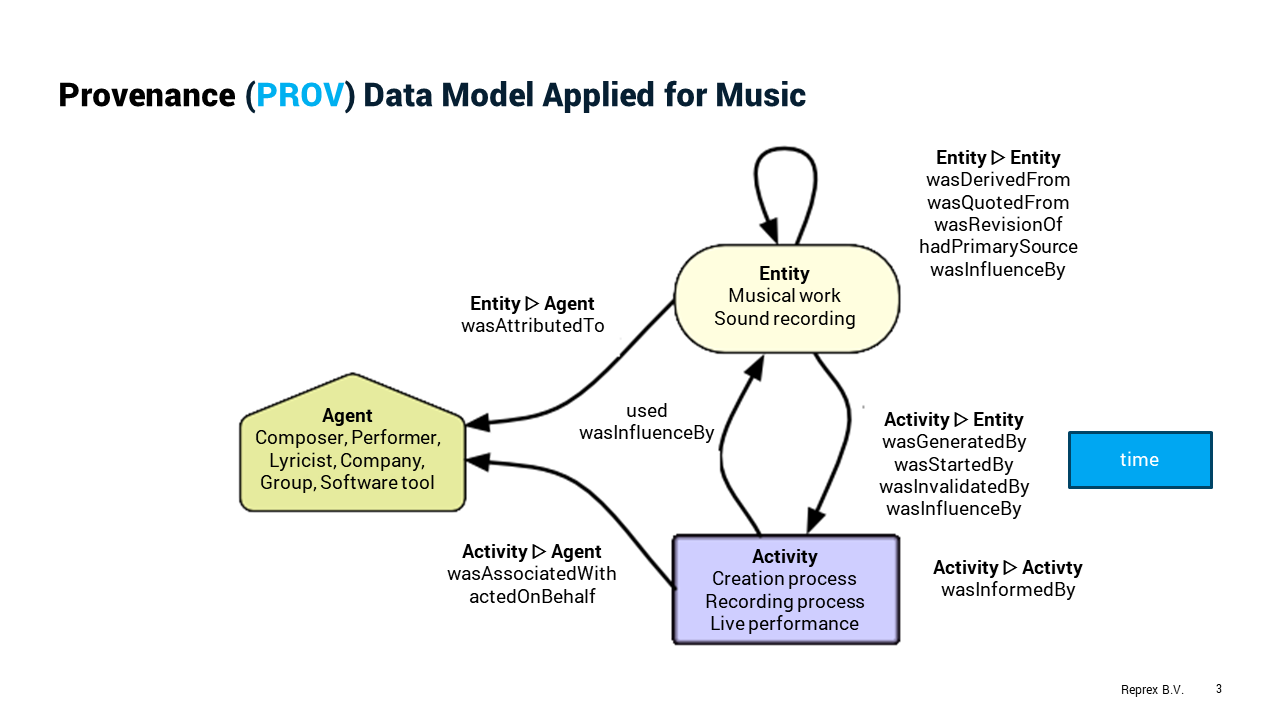
A generalised data model about the relationships between ⏩ Activities (such as creation, recording, …), the ⏩ Agents involved in these activities (performers, record labels, …) resulting in abstract ⏩ Things (Music Entities) like musical works, recording, concerts…
Wikibase Data Model

Reprexbase is based on Wikibase.
Add a new person
The person
Zoltán Kodályis not the same thing as the nameZoltán Kodály. There may be many persons who use this full name.To avoid confusion, we use unique identifiers for each person (later slide.)
Because in human language we use names, it is important to attach the name(s) of a person to the Wikibase entry of the person: to add
BélaandBartókto the modern composer as a person.
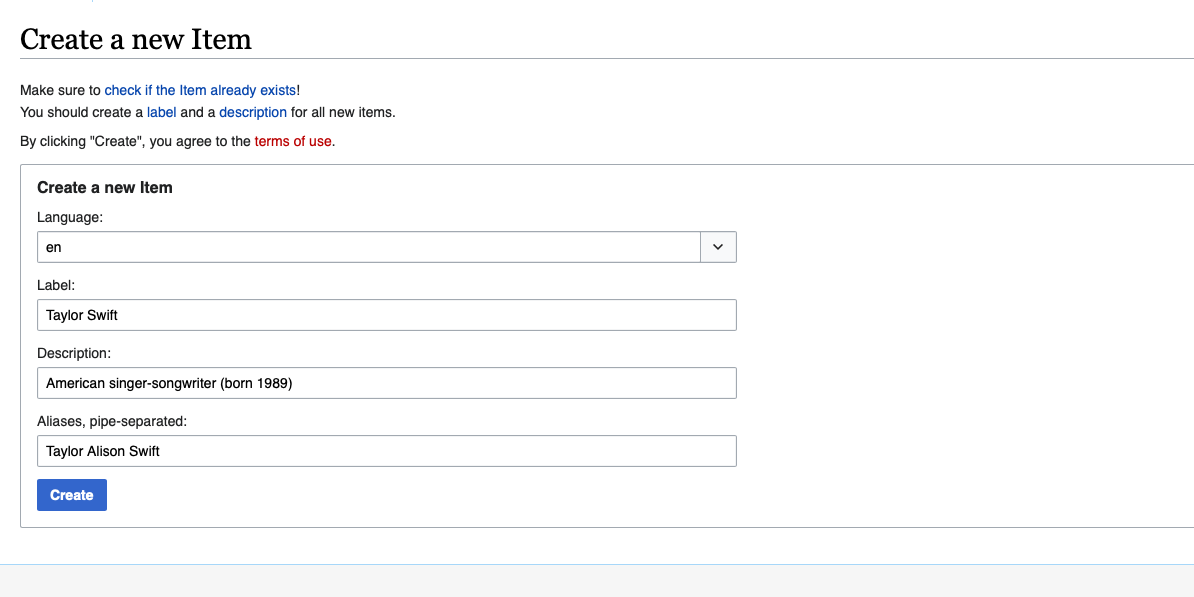
- For adding a new agent to our knowledge base or a data sharing space, you need to fill out at least in one language (English) a label and a description for each Agent.
Log into a Wikibase instance, for example, to this wikibase instance⇗.
Choose Special pages⇗ (You can find it on the sidebar).
Press Create new item⇗.
Fill in English
labelwith the English (Wester) name of the person, (f.e. Taylor Swift) into thedescription fieldprovide a short description of the person, (f.e., American singer-songwriter), and potentialaliases, for example, birth name (f.e., Taylor Alison Swift.) Use the aliases only for name variants.
- Examples: Taylor Swift (Q58)⇗, Taylor Swift (Q26876)↗ Béla Bartók (Q294)⇗, Béla Bartók (Q83326)↗. The equivalent entity items have different numbers in each Wikibase instance.
Define the new person
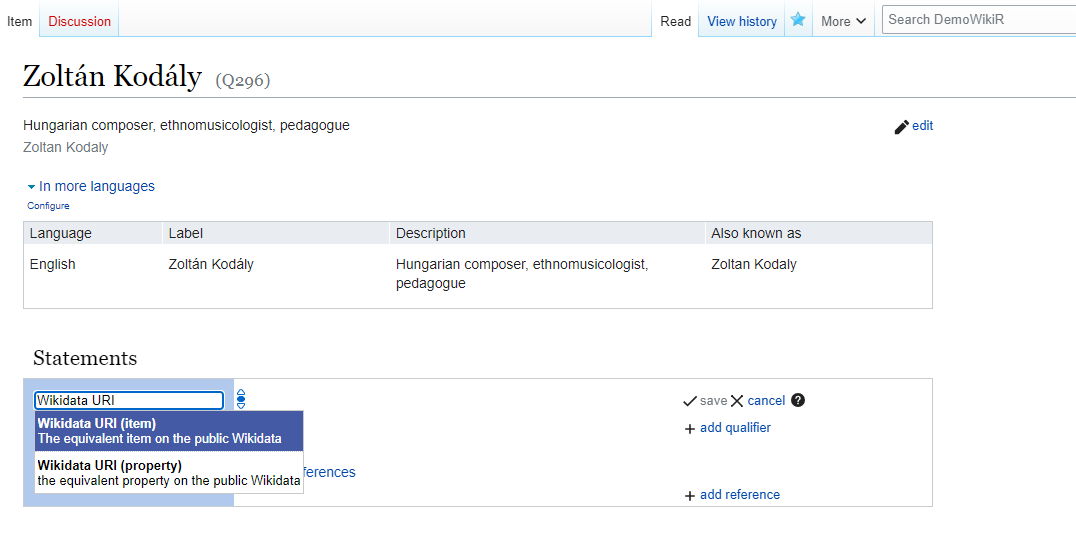
Scroll to the
Statementspart below the definition box of the person, for example, Wikidata URI (item) (P73)⇗.Press
+add statement.The subject of the statement is the person whose page your are editing (for example,Zoltán Kodály (Q296)⇗).
Scroll down and choose a property, or add directly the property number. The predicate about the person is always connecting via a property item, for example, Wikidata URI (item) (P73)⇗, or [instance of (P2)]https://reprexbase.eu/demowiki/index.php?title=Property:P2), or given name (P71)⇗. The actual links and the
Pnumbers are different in each Wikibase instance.If the person has a Wikidata page, the first statement that you enter should be the Wikidata URI (item) (P73)⇗, for Zoltán Kodály this is https://www.wikidata.org/wiki/Q153008.
The second statement should be a
class; you should be as specific as you can be with confidence. Is Zoltán Kodály a human↗? A living or deceased person↗? A music professional⇗? More specifically a composer↗? Is composer too specific? In this case, it is too specific, because Zoltán Kodály performed many music-related activities.Our Reprexbase instances use the same classification as Wikidata when we believe that it is useful. For example, Wikidata uses dead human↗, but our preferred label is
deceased person. Or we use a music professional↗ term for people who work professionally with music, but not necessarily in an artistic role (i.e., tour managers, sound engeinners qualify, too.)You can add several
instance ofstatements, for example, if your Wikibase already defined it, you can call Zoltán Kodály both a composer↗ and a music educator↗, but not as an author name string↗ (Ourmusic educatordefinition is more refined than Wikidata’s, but they can be treated equal for data linking.)
- Examples: Taylor Swift (Q58)⇗, Taylor Swift (Q26876)↗ Béla Bartók (Q294)⇗, Béla Bartók (Q83326)↗. The equivalent item entities have different numbers in each Wikibase instance.
Add Name
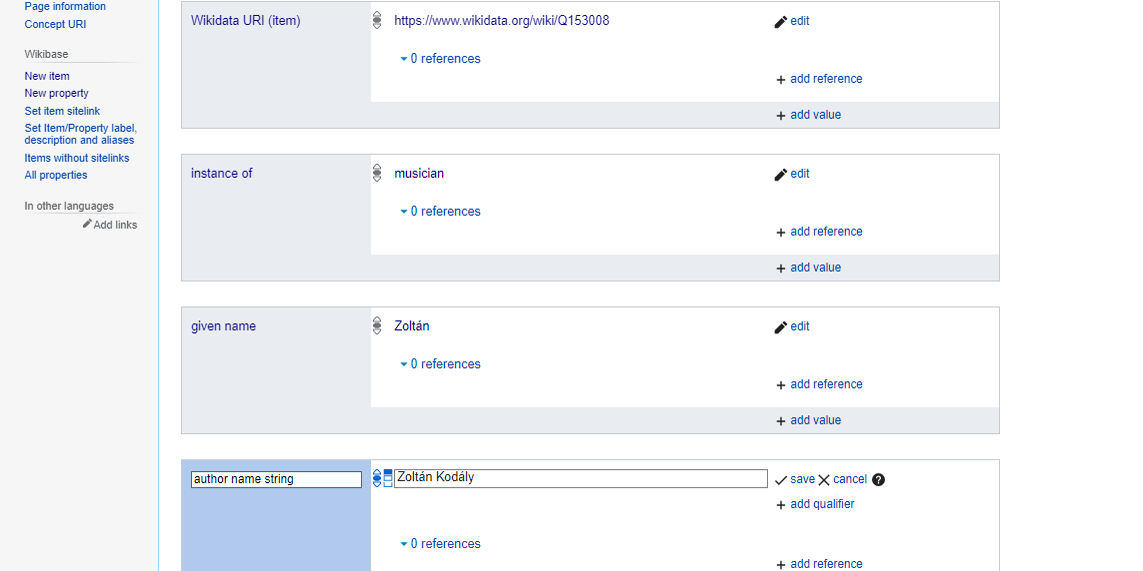
Add the name as a string, for example, for authors, using the author name string (P2093)↗ property. The
author name stringproperty is used to mass-import names from library catalogues.The problem with name strings is that they may have several (spelling) versions, different name orders in various languages, and they may have spelling errors.
Whenever possible, we use controlled names. This means that after typing
Zoltán Kodály, you try to addZoltánas a given name (P735)↗ property (see next steps.)
Add the name as a string, for example, for authors, using the author name string (P2093)↗ (P230)⇗ property. The
author name stringproperty is used to mass-import names from library catalogues.Type the name, for example,
Zoltán Kodály. If the main language of the Wikibase is English, use the English (Western) name order.You can skip this step if you find both the
given nameand thefamily namein the instance as a controlled entity (item). (See next slide.)
Manage Given Name(s)
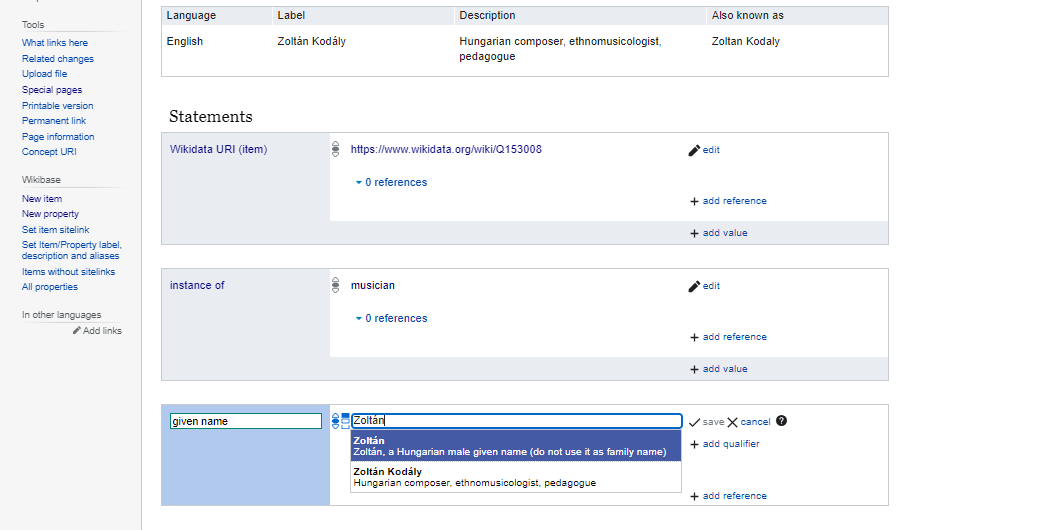
Try to use the given name (P735)↗ (P71)⇗ property and find the name as an entity (item) in your Wikibase. If the given name is present, it contains knowledge about archaic spellings, spelling variations, and other information about its correct use. A
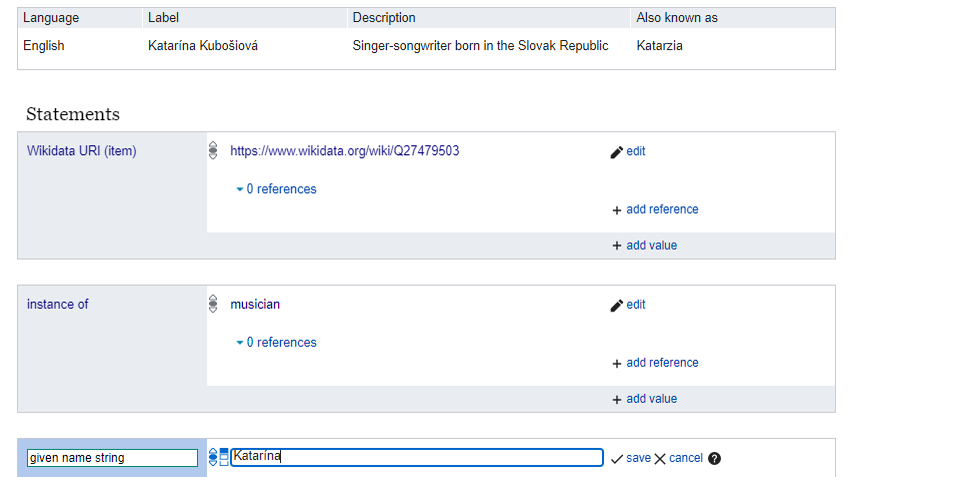
given nameis more useful than theauthor name string, because it makes it clear thatZoltánis a given name (in the Hungarian language, it can be a family name, too.)If you do not find the given name as a pre-defined entity (item with a Q number), you can add it as a
given name string. Agiven name stringis still more useful than theauthor name string, because it makes it clear thatKatarínais part of the given name(s) of the artist. In our example, we addedKatarínawith Slovak spelling to the entry of Katarína Kubošiová (Katarzia)↗-Katarína Kubošiová (Katarzia)⇗. You can add several given names, if necessary.
Manage Family Name(s)
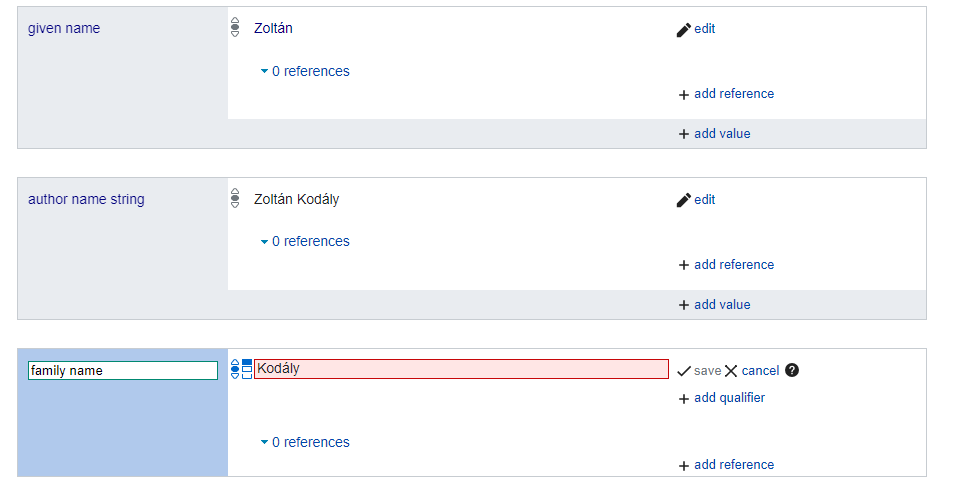
Try to use the family name (P734)↗ property and find the name as an entity (item) in your Wikibase. If the family name is present in this form, it may contain knowledge about archaic spellings, spelling variations, and other information about its correct use. A
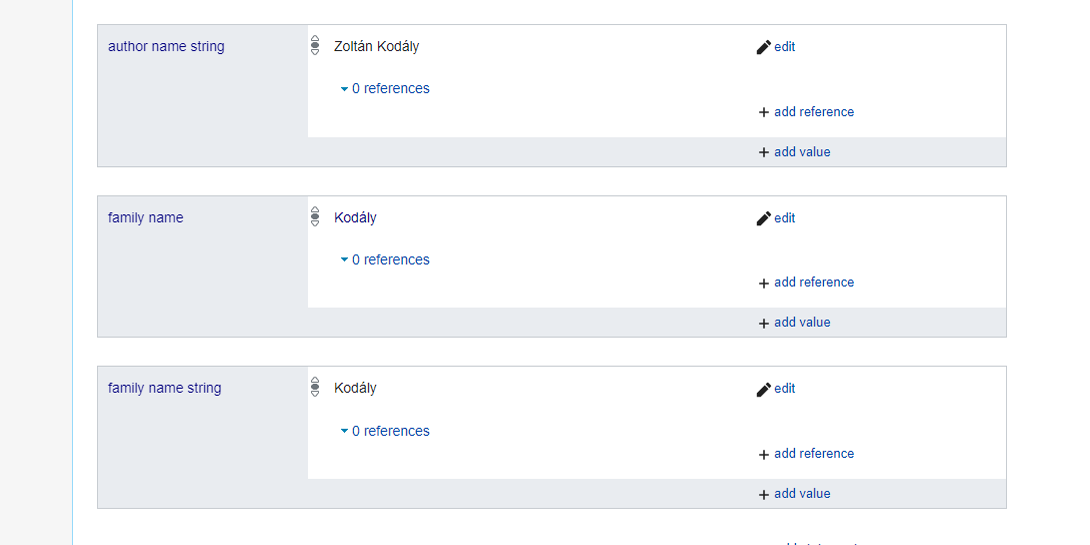
family nameis more useful than theauthor name string, because it makes it clear that Kodály↗ is a family name.If you do not find the given name as a pre-defined entity (item with a Q number), you can add it as a
family name string. Afamily name stringis still more useful than theauthor name string, because it makes it clear thatKodályis part of the family name(s) of the artist. In our example, we addedKodályas a string and Kodály↗ as an item. It is not a problem if you add both. (It is likely that theKodálystring is added first and then it is matched with Kodály↗.)Beware that Kodály↗ is not a family: it is a
family name. Many unrelated people may use the same family name (or surname). Family relations must be entered in a different way (not part of this tutorial.)
Identifiers
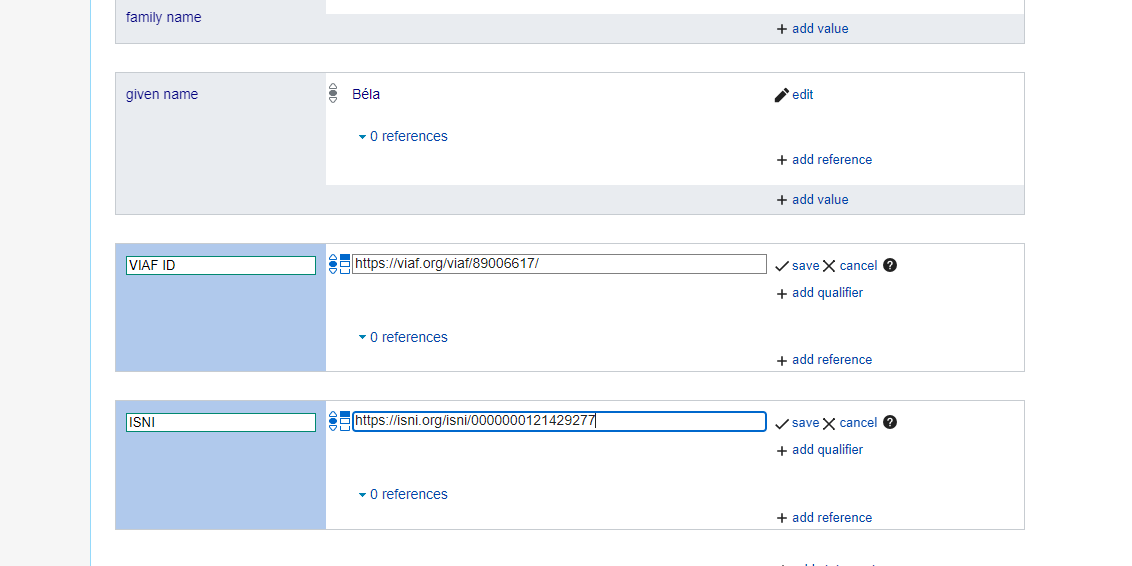
Many people may have the same name, but only one of them should have the same authority file or PID identifier.
We must use globally unique identifiers to connect data, information or knowledge about the same persons in different databases.
Our preferred identifiers as
VIAFto connect library catalogues,ISNIfor an ISO standard name identification, and the WikidataQID, because it allows us to connect to many more identifiers and data sources.Tip: you can add multiple identifiers with starting several+add statementfields.
- Under the definition of the person select
+add statement.
2 Select the VIAF ID (P214)↗- VIAF ID (P13)⇗ property and/or the ISNI (P213)↗ - ISNI (P226)⇗. The equivalent properties have different numbers in each Wikibase instance.
Add the URIs in canonical form to the the statement, for example, https://viaf.org/viaf/89006617/ or https://isni.org/isni/0000000121429277.
You have probably done this earlier, because the Wikidata URI (item) (P73)⇗ is a similar global identifier. Whenever possible, we add it as a first statement. (It has no Wikidata equivalent↗, it helps to connect us to the Wikidata equivalent.)
Examples: Taylor Swift (Q58)⇗, Taylor Swift (Q26876)↗ Béla Bartók (Q294)⇗, Béla Bartók (Q83326)↗. The equivalent entity items have different numbers in each Wikibase instance.
Enter new language labels

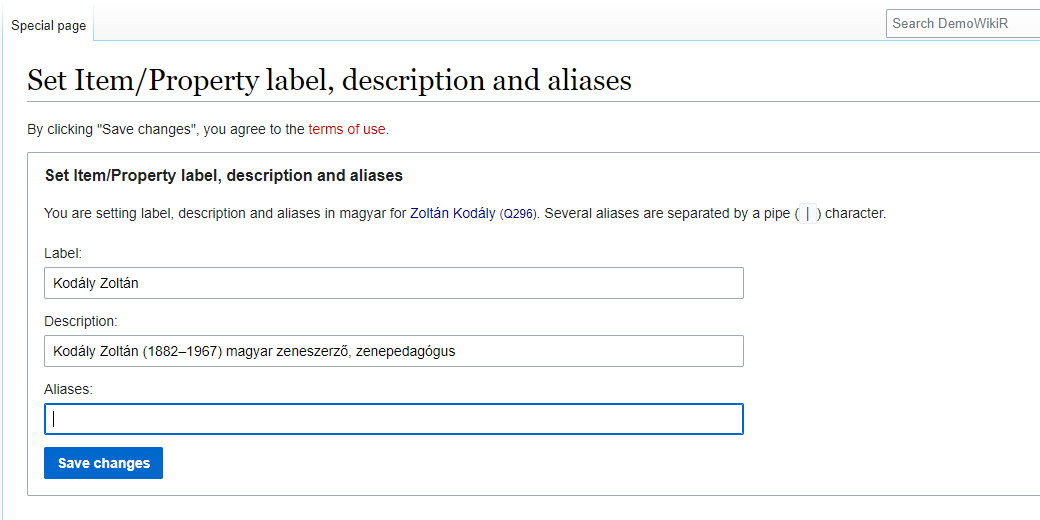
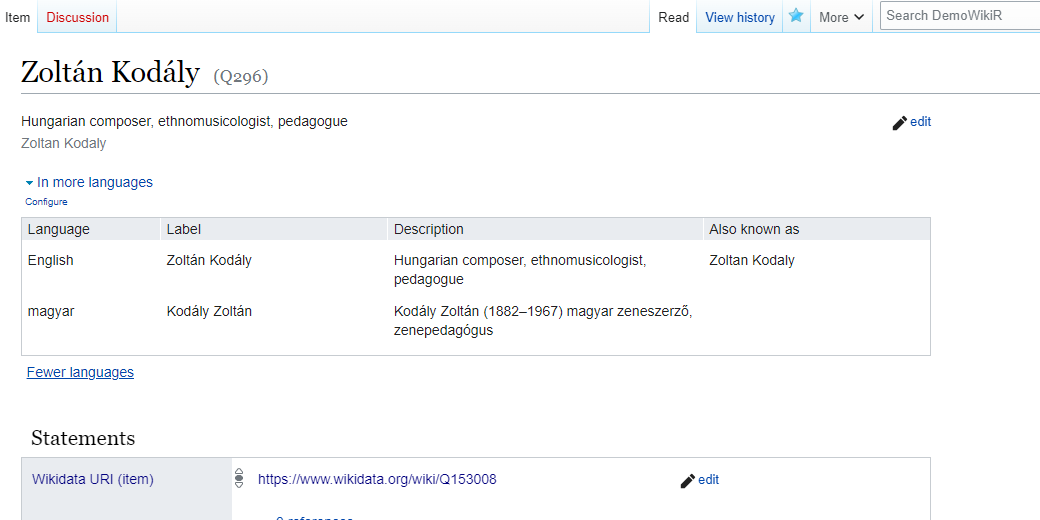
Press on the sidebar or on the Spacial pages Set Item/Property label, description and aliases ⇗.
Add the
QIDof the item where you want to enter a new language. For Zoltán Kodály, this isQ296. You can see it from the URL of the item: https://reprexbase.eu/demowiki/index.php?title=Item:Q296 (ending withItem:Q296.)Select the two-letter language code of the next language.
Add the label and the description in the new language. You may add language-specific aliases.
Birth name
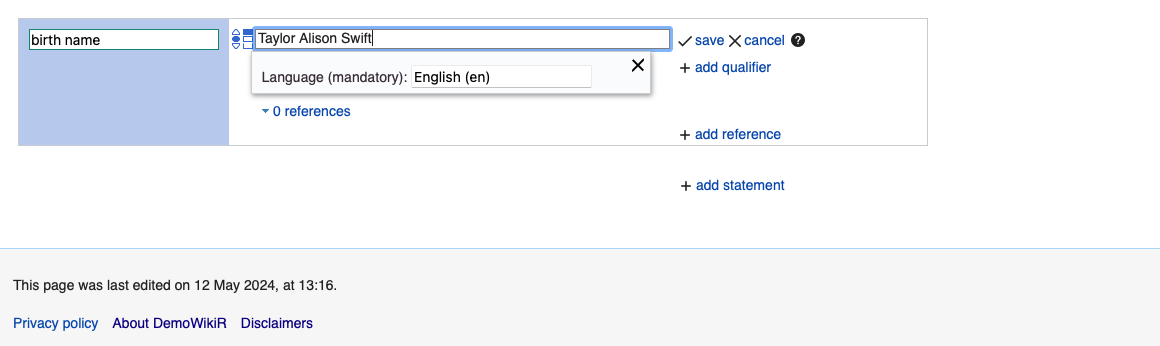
The full name of a person at birth can be different from their current, generally used name.
Birth names often change when people get married and start a new family under a new family name.
Artists often choose a variation of their name that identifies them better. There may be many reasons why a person or agent has a different name at birth (or creation) than later.
The birth name is a
name stringin the spelling and name order of the (original) language.
- Under the definition of the person select
+add statement.
2 Select the birth name (Wikidata)↗ property - in our Wikibase birth name (P299)⇗.
Type in the
birth nameas a string, and select thelanguage.Examples: Taylor Swift (Q58)⇗, Taylor Swift (Q26876)↗ in English and Zoltán Kodály (Q296)⇗ with a Hungarian birth name.